Showing posts with label Twilight Time. Show all posts

Thursday, September 3, 2015

State of Grace (1990, Phil Joanou)


In its relatively short life as a mid-major, Orion Pictures took home an impressive number of prestigious nominations and awards, including four Best Picture wins.  Today, the studio is most remembered for those successes and for its highly-publicized bankruptcy and eventual dissolution, which coincided with the back-to-back triumphs of Dances with Wolves and The Silence of the Lambs. When I think of Orion, however, it's not really for its most acclaimed titles, it's for its remarkably consistent run of intelligent and adventurous mid-budgeted pictures from the late '70s (when it was partnered with Warner Bros.) through the early '90s.

So many of my favorite films of the '70s-'80s begin with this memorable logo.

Phil Joanou's State of Grace comes at the end of this era and is, in fact, one of those highly unprofitable pictures that led to its parent company's demise.  A mob picture in a year full of high profile examples of the genre--Goodfellas, Godfather: Part III, Miller's Crossing--State of Grace was quickly in and out of theaters and out of the public consciousness.  I caught it a few years later on VHS, as a teenager, when I was making my way through the Sean Penn filmography (the film has the distinction of being Penn's final movie before his first retirement from acting) and then, again, a few years after that when a good friend of mine really sold me on its virtues. After this second introduction to the film, it became a favorite of mine due to its impressive cast and magnetic performances, very quotable dialogue, haunting Morricone score, and its pervasive gloominess and lack of sentimentality.  The latter qualities struck me as out-of-fashion then and, as Joanou notes on the fascinating commentary track on Twilight Time's new Blu-ray, time has only accentuated them.

Ed Harris as Frankie Flannery.  His performance might get lost behind those of Penn, Oldman, and Wright, but it shouldn't...this is his one of his best.
Jackie (Gary Oldman) in a rare contemplative moment at the bar, where he is most at home.

The kind of mid-budget drama that has very rarely been made by the studios post-'90s, a loss that Joanou laments on the aforementioned track, State of Grace is also an homage to the gritty 1970s cinema that so inspired Penn and Joanou.  To the film's credit, this was several years prior to the '70s revival when these sorts of tributes became de rigueur and stale.  Finally, as also discussed by Joanou and commentary moderator Nick Redman, in the 25 years since the film's initial release, New York City has become a drastically different place than when the film was shot there in 1989; like so many other films, the passage of time has made State of Grace an invaluable document of the place and time in which it was created.

Ed Harris and R.D. Call mean business.

Made just a few years before citywide clean-up and redevelopment efforts would really take shape, the film shows the city, midtown and downtown Manhattan in particular, when large swaths of it remained as they were in the "Wild West"-like 70s, some combination of unsafe, dirty, decrepit, underpopulated, and cheap...ripe conditions for a gang like the Westies to prosper. Much of the screenplay by playwright Dennis McIntyre and an uncredited David Rabe is inspired by the Irish gang's exploits in '70s and '80s Hells Kitchen; not so ironically it was federal prosecutor Rudolph Giuliani who would take down the Westie leadership of this era and later, as mayor, spearhead the gentrification and Disneyfication of their former territory.

I always thought that Sean Penn resembled Westie Jimmy Coonan in this mugshot of the gangster.

McIntyre and Rabe's major creation is Penn's Terry Noonan, a native of the Kitchen who has mysteriously returned to his old haunts after many years away, and reconnected with his best friend Jackie Flannery (Gary Oldman), Jackie's sister and Terry's childhood girlfriend Kate (Robin Wright), and their brother and boss of the gang, Frankie (Ed Harris).  Noonan's reunion with the Flannerys coincides with Frankie's efforts to align his gang with Italian mobster Borelli (the one-of-a-kind Joe Viterelli playing a character possibly based on Gambino boss Paul Castellano).  As the crazed Jackie, Oldman delivers an electrifying, scenery-chewing performance that ensures that the picture never really lacks energy; Penn has done that kind of thing before, but here he is the straight man, letting his face and body language communicate his character's inner torment.  And, the chemistry between he and his future wife Wright is palpable and she matches the heavyweights around her...it had to be something of a revelation in 1990 when her only previous exposure had been on Santa Barbara and as Princess Buttercup.  I don't know if Harris has ever been scarier than he is here, thoroughly convincing when playing the authoritative boss of his gang and humorously child-like when in the presence of Viterelli.

"You're cold, Kate." - Terry Noonan

The supporting cast includes a young John C. Reilly (cast on Penn's recommendation, following their work together in De Palma's Casualties of War), the ice cold R.D. Call (another frequent Penn collaborator--At Close Range, Colors, and several others), John Turturro, an uncredited James Russo, Marco St. John, Thomas G. Waites, and the great Burgess Meredith in one of his final roles (he has a brief, but heartbreaking scene, the casting of which Joanou beautifully recalls on the commentary track).  The movie, like so many other well-known gangster films is a modern Greek tragedy, and on this most recent viewing, I found it as powerful and mournful--with some darkly humorous moments sprinkled in the earlier parts of the film--as I always have; I did feel this time around, though, that it could have been trimmed a bit. That minor criticism aside, I maintain that the film is one of the most underrated films of the '90s and undeservedly unsung gangster films of any era.

"Scary Terry" Noonan.

With the aforementioned Morricone, Rabe, and cast, as well as cinematographer Jordan Cronenweth, editor Claire Simpson, and production designer Patrizia von Brandenstein, the young Joanou truly had a Murderer's Row of creative collaborators on this show and, unsurprisingly, it is a handsome production in all aspects.  This is to say that the new Twilight Time Blu-ray is a very worthwhile upgrade from the old DVD, with the HD presentation more faithfully representing Cronenweth's intricate lighting, von Brandenstein's carefully designed sets and, of course, the "dirty old New York" practical locations.  We also get a booklet with Julie Kirgo essay and Morricone's memorable (and also underrated) score on an isolated track. Morricone wrote more music for the film than appears in the final cut; I'm not sure if the isolated track includes all of this, so I will hang onto my long out-of-print CD.

The much-lauded playwright David Rabe, some years prior to State of Grace.  Sean Penn would later star in the film version of Rabe's Hurlyburly.  The 16mm print of State of Grace that I ran in college one St. Patrick's Day had a very prominent "special thanks" credit for Rabe at the top of the end credit role that I've never seen on any other version of the film.

Finally, to get back to where I started here, with Orion Pictures, it should be noted that State of Grace represents the final film in a long-running and very fruitful relationship that Sean Penn had with the studio, a relationship that led to The Falcon and the Snowman, At Close Range (coming soon from Twilight Time!), and Colors. Quite an exemplary grouping, I think.

Penn and Joanou on set.

Friday, August 21, 2015

Summer Lovers (1982, Randal Kleiser)


Now, here's a Blu-ray I never thought I'd see.  Twilight Time, through their license agreement with MGM, have given Randal Kleiser's Summer Lovers its first-ever widescreen home media release. But, where most other companies, including MGM, likely would have issued the film in barebones fashion, Twilight Time have gone the extra mile and included a candid feature-length audio commentary by Kleiser, an isolated score / fx track, two theatrical trailers (regular and red band), a documentary on late composer Basil Poledouris, screen tests (featuring Patrick Swayze, Hart Bochner, and Valerie Quennessen!), a booklet with Julie Kirgo essay, and the mythical--to Summer Lovers fans like myself, anyway--The Making of Summer Lovers, a vintage featurette shot on location in late 1981 and seemingly unseen since the film's original release in 1982.


I've written about the film here previously, but to recap briefly: the plot centers on Michael and Cathy (Peter Gallagher and Daryl Hannah), a young American couple vacationing on Santorini, who enter into a summer-long menage a trois with Lina (Valerie Quennessen), a French archaeologist working on the island. After having viewed the film for the umpteenth time via the new Blu-ray, I maintain that the film would have benefited from portraying a sexual relationship between the two women (Daryl Hannah and Valerie Quennessen) and concluding on a more subdued, realistic note than does the shiny, happy Pointer Sisters-fueled ending we currently have.  All that said, the film remains a personal favorite of mine, an escapist treat that never ceases to raise my spirits, and which inspired me to travel to the Greek Isles on more than one occasion, including Santorini, the film's main location. Like a lot of films from its era, it has an earnestness and lack of irony that I love, but many will read today as "cheesy."


Kleiser was inspired by then-recent French art cinema to go where few, if any, mainstream American films had gone before and depict a polyamorous relationship in an honest and realistic manner, along with the casual, non-sexual nudity that was usually anathema to Hollywood. But, he had to balance this narrative goal with the obligations of a major summer release.  So, it is a light and bubbly film in most respects, with the kind of infectious, joyous pop music score and montage sequences expected from the filmmaker behind Grease.  There are, however, undercurrents of sadness and mystery, mostly coming from the character of Lina and Valerie Quennessen's nuanced and moving portrayal of her.  That this would be the luminous Quennessen's final film performance and that she would tragically die in an auto accident several years later grants the film an extra, unintended layer of melancholy.  And, in spite of the film coming out in the Reagan years, it has a refreshingly non-conformist, open-minded spirit that feels like a holdover from the previous decade.


As the years have gone by, the film has increasingly become valued as a cinematic time capsule of pre-AIDs attitudes towards sex and "open" relationships.  This notion is given extra resonance on Kleiser's commentary track when he memorializes numerous talented crew members who were felled by AIDS in the next several years after Summer Lovers' completion.  


The aforementioned Quennessen (those eyes!) is the highlight for me and numerous other viewers who have made this film a cult item over the ensuing years.  That said, the unfairly maligned Daryl Hannah brings an integral charm, sweetness, and sense of curiosity to the film, qualities seemingly underrated by most people not named Ron Howard.  The film is at its best when Hannah and Quennessen are in sync, either teasing Peter Gallagher or speaking about him with genuine affection. Gallagher was also treated pretty unkindly by critics when the film was released, but I think his sense of comic timing and willingness to poke fun at himself (not to mention going full frontal) is woefully under-appreciated.  The physical comedy of his first strip down on the beach cracks me up every time I watch it and it was interesting to hear from Kleiser that these beats were improvised by the actor on set rather than being in the script.


As a soundtrack aficionado, I can't not mention the music here, from the impossibly upbeat title track by Michael Sembello to the possibly even more upbeat "I'm So Excited" to Tina Turner's great cover of "Johnny and Mary" to Lime's classic "Your Love." Basil Poledouris' all electronic--Vangelis and Jean-Michel Jarre-inspired?--New Age score, adds immeasurably to the film's mood in its more introspective moments, none more so than when Gallagher first lays eyes on Quennessen.  As with most Twilight Time releases, all the music is here on an isolated track, although in this case it's a music and effects track, unfortunately.  I can only guess that with several changes in the film's ownership (Filmways to Orion to MGM) over the years, Poledouris' score tapes have gone missing.   


With the new HD master used as the source for Twilight Time's Blu-ray, it's safe to say Summer Lovers hasn't looked better since its original theatrical release...and the film itself has gotten better with age.  It's not an entirely successful mashup of beach party movie and Rohmer (I don't know that any movie could be), but its heart is in the right place and it remains unique in its attempts to bring a "free and open" European flavor, as well as the complications of a polyamorous relationship, to the summer popcorn movie season.


The 1981 Filmways logo (one of my favorite studio logos) that preceded Summer Lovers when first released in 1982.  Unfortunately, it has not been restored to the new Blu-ray, which instead begins with an Orion logo:

Thursday, February 12, 2015

Breaking Away (1979, Peter Yates)


Peter Yates' Breaking Away is such a longtime favorite of mine, a movie I've loved for so long and know backwards and forwards, that it's difficult to write about it with any kind of objectivity.  The story of a group of small-town pals in that awkward phase between childhood and adulthood is, on paper, unexciting, but the treatment it's given here results in a film that is universal and timeless, eminently quotable, rousing, funny, full of charm, emotionally rich, and profoundly moving.


Very much a post-Rocky film, it shares with that other classic sports film of the late '70s, a exquisitely-drawn collection of singular characters and a vitally strong sense of place, in addition to the requisite "get on your feet and cheer" sporting event finale.  They both have that slightly messy-opposite of slick-offbeat, but real quality that went out with the '70s.

Cycling and Italy-obsessed Bloomington, Indiana high school grad Dave Stohler (Dennis Christopher) hangs with his good friends Mike (Dennis Quaid), Cyril (Daniel Stern), and Moocher (Jackie Earle Haley) without much thought for the future, except for which bike race he's going to sign up for next.  All of this is anathema to his blue collar, ex-stone cutter, car dealer dad (Paul Dooley) who has no idea how to connect with his boy.


Even though everything leads to an expertly mounted, supremely satisfying final race, it is the alternately hilarious and poignant interplay between Dave and the other characters, as well as the accurate portrayal of '70s middle America--specifically Bloomington--and subtle class commentary that constitute the film's lifeblood, the things that make it truly something special.


Breaking Away was a 5-time Oscar nominee and a winner for Steve Tesich's original screenplay, but by the time I discovered the movie for myself as a young teenager, it was nearly 15 years-old.  Like several movies I latched onto at that formative age, it was out of fashion (unless you were on the IU-Bloomington campus, I guess), in between its initial popularity and eventual revival as a modern classic.  In those pre-Internet days, it was not a movie that my peers were aware of and I never saw it appear on network television or cable.  Between thumbing through my Ebert, Maltin, and Peary movie guides and visits to the drama section in the video store, I stumbled upon Yates and Tesich's superior coming-of-age / sports movie hybrid and immediately fell under its spell and, as with other favorites of mine that no else seemed to care about, I did my damnedest to spread the gospel to friends and acquaintances.


Somewhat remarkably, until the late '90s, Fox never released the movie as a sell-through on VHS; it remained priced for rental in spite of its Oscar pedigree and cast of future stars.  I eventually bought the film on laserdisc (originally issued in 1981), which remains the worst quality laserdisc I ever viewed or owned.  These things, I think, contributed to the film's obscurity by the time I was 13 or 14 and first becoming aware of it.  Eventually, there was a sell-through VHS, featuring an updated transfer and, later, a DVD, which marked the film's first widescreen release on home video, but which included only the trailer and tv spots as extras.  All of this is to say that Twilight Time's new Blu-ray--with gorgeous new transfer, informative commentary track with star Dennis Christopher, and Patrick Williams' marvelous adapted and original score isolated on another track--is especially gratifying and looks particularly beautiful to my eyes after having experienced the film for so long in poor quality editions.


As for the film itself, it is one of the best of the '70s, something years of woeful home media iterations could never take away from it.  The much-improved technical presentation does accentuate and finally do justice to d.p. Matthew Leonetti's very attractive lensing and Patrizia von Brandenstein's equally impressive art direction.  Both aspects of the production are suitably unfussy, never calling undue attention to themselves while contributing to the film's carefully achieved level of visual realism. What never suffered was Tesich's delightful, autobiographical screenplay given life by a once-in-a-lifetime cast. Dooley and the Oscar-nominated Barbara Barrie as Mr. and Mrs. Stohler, the aforementioned Quaid, Stern, and Haley, Robyn Douglass as the co-ed who Dave woos. And, of course, the truly wonderful, ever-lovable Dennis Christopher as Dave.


When I was younger, it always made me sad that Christopher, who performed so beautifully and memorably here, never had another film role of this caliber; one of the chief pleasures of the Twilight Time Blu-ray is getting to hear Christopher share his memories of making the film and his gratitude to it for what it provided him. Ironically, Christopher would appear a couple years later in Chariots of Fire, alongside the late Brad Davis, who delivered his own knockout, star-making performance in 1978's Midnight Express (alongside elder Quaid brother Randy); similarly to Christopher and equally saddening to me, none of Davis' subsequent parts matched the stature and impact of his breakout role.


As a teenager and young twenty-something, it was the kids and their camaraderie that I was drawn to, that I wished I'd had when I was in high school, but when I watch it as an adult, with the experience of the premature loss of my father in mind, it is the film's portrayal of parent-child relationships, or lack thereof, as well as its deft portrayal of class differences that are most striking to me.  The push-pull dynamic between Dave and his father; the quiet, but steady love of the ever-wise Mrs. Stohler; the continual absence of parental figures for the other boys, particularly Cyril; the insecurity that leads Dave to pretend he's Italian in order to impress a college girl.


Twilight Time's disc is a beauty, a long time coming, and one that I will treasure for the long haul.

Saturday, December 6, 2014

Under Fire (1983, Roger Spottiswoode)


If that old canard about the Hollywood "liberal bias" were true, I think films like Roger Spottiswoode's Under Fire would be a lot more common than they are.  It just so happens that Twilight Time has, of late, seemingly cornered the market on these few '70s and '80s Hollywood-produced dramas set in war-torn countries in which the U.S. government had a dubious, at best, presence.  


Under Fire depicts journalists Nick Nolte, Gene Hackman, and Joanna Cassidy in a Somoza-led Nicaragua on the brink of collapse. Oliver Stone's more pointed Salvador has photojournalist James Woods in an El Salvador torn apart by civil war.  Richard Fleischer's Che is a Che Guevara biopic. And, John Irvin's The Dogs of War examines a soldier-for-hire (Christopher Walken) and his team of mercenaries sent into a fictional African country to overthrow a dictator.  Somewhat amazingly all of these titles have been issued by Twilight Time in quick succession.


Under Fire is an impressively mounted production, with a very fine trio of lead performances--the aforementioned Nolte, Hackman, and Cassidy--supported by a very strong Ed Harris, who is particularly chilling, the great Jean-Louis Trintignant, and Richard Masur.  Jerry Goldsmith contributes one of his most gorgeous and memorable scores, with key support from famed jazz guitarist Pat Matheny. Lastly, but no less important a credit is that of d.p. John Alcott, most renowned for his work as cinematographer for Kubrick on A Clockwork Orange, Barry Lyndon, and The Shining.

Hackman and Cassidy would reunite several years later in Andrew Davis' The Package, also from Orion and also newly released on Blu-ray.

In its set-up and through its second act, I found Under Fire riveting; where it lost impact for me, in contrast to Stone's Salvador and Costa-Gavras' Missing, is when its focus shifts from the political to the personal, from the reality-based situation on the ground in Nicaragua to the fictional love triangle between Nolte, Hackman, and Cassidy. The filmmakers ease up on their criticism of the U.S. government for its support of dictator Somoza and his efforts to put down the leftist Sandinista revolutionary movement in favor of the aforementioned love story and an implausible, cliche-ridden action thriller climax. To be fair, the latter is inspired by the real-life murder of ABC news reporter Bill Stewart.  


The film is at its best and most blood-boiling whenever the shameless, cruel soldier of fortune Harris is onscreen.  He pops up at various times throughout the story, whether in Africa or Central America, and he, along with Trintignant's wealthy French spy / informer, is the stand-in for capitalist greed and indifference, but the film would have been stronger if it were more direct in its critique of the U.S. government and U.S. corporations for their complicity in and profiteering from the crimes of Somoza and his ilk throughout Central and South America.  The great Harris performance is akin to Mickey Rourke a few years earlier in Body Heat, briefly stealing the film out from under its lead actors whenever he's onscreen.

The rabid baseball fan in me loved the film's reference to Nicaraguan native and one-time Major League Baseball star--and Baltimore Oriole, as you can see--Dennis Martinez

Twilight Time's Blu-ray features a handsome, film-like transfer, which does not appear to have unwelcome digital tampering, and contains the requisite isolated score (I listened to my LP of the soundtrack while writing this), as well as Julie Kirgo's informative printed notes, an interview with female lead Joanna Cassidy, an original trailer, a photo gallery, and two audio commentaries with director Spottiswoode, TT's Nick Redman and Kirgo, and other crew members.

Wednesday, November 5, 2014

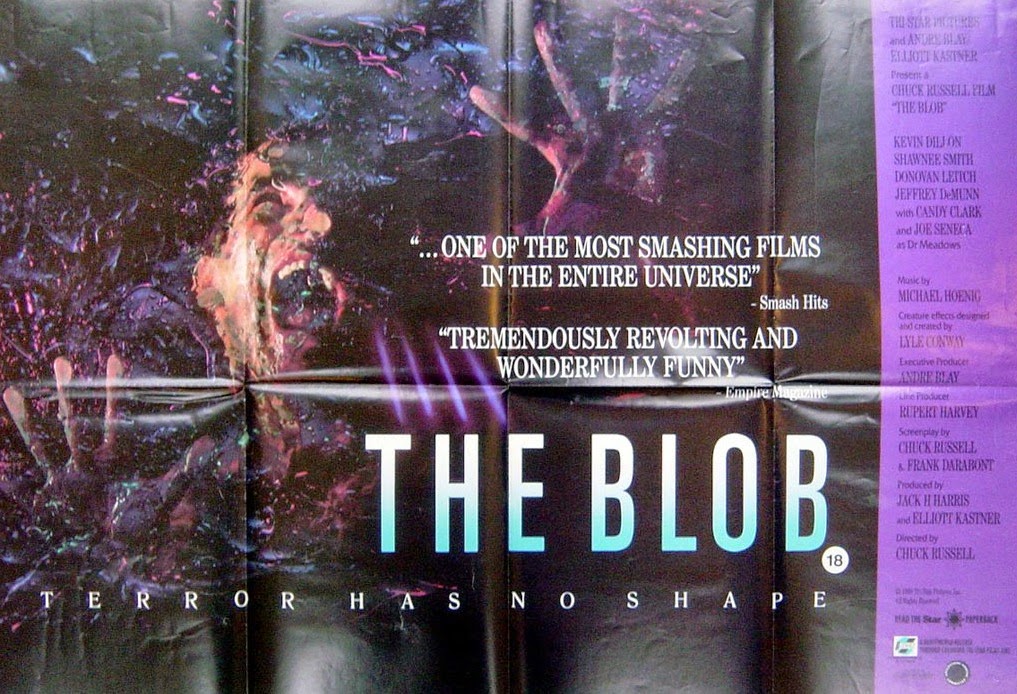
The Blob (1988, Chuck Russell)


Aside from Kevin Dillon's godawful mullet, I really can't say too many bad things about Chuck Russell's 1988 Blob remake.  Twenty-six years on, it remains a supremely enjoyable, well-crafted monster movie romp.  Now, via Twilight Time's new limited edition Blu-ray (already sold out), we can enjoy the film in HD, along with some new extras including an audio commentary track with director and co-writer Russell and an isolated score track, featuring the music of German electronic composer Michael Hoenig.

This Blob holds a special place in my heart, as it is one of several mid to late '80s horror films that my late grandfather took me to see when I was a horror-crazed young boy.  I had probably seen the film again within the last twenty-odd years or so via cable, but as I revisited the film this time, I found myself treasuring those memories of seeing the film for the first time with grandfather, known as Pop-Pop to my brother and me.  Pop-Pop was the first adult to recognize my deep-seated love of movies and when I turned to horror around the age of eight or nine, he allowed me to indulge my newfound fascination and curiosity with those films, as well as comics.  I never cease to chuckle when I recall the time he took my brother and me to see David Cronenberg's The Fly (shot by Blob d.p. Mark Irwin).  Pop-Pop was not very fond of that film's gore, which increased exponentially as Jeff Goldblum's human features deteriorated and his transformation into the fly accelerated.  At a certain point, around when Goldblum loses an ear in the bathroom, Pop-Pop got up in a huff, with my brother (then 5) in tow, and said to me: "You can stay here if you want.  Your brother and I will out front."  Needless to say...I stayed.


It was while watching the interview (at the Cinefamily) with Chuck Russell, on the TT disc, that I was reminded that Russell directed not only The Blob, but also the much-beloved Elm Street sequel, Dream Warriors, yet another '80s horror classic that Pop-Pop took me to.

Anyway...back to The Blob.  Russell and co-writer Frank Darabont have slyly updated the '50s Cold War, Steve McQueen-starring chestnut to the '80s, while retaining the feel of any number of golden era B-movies--be they horror, sci-fi, or juvenile delinquency drama--firmly implanted in small town Americana.  I love the use of that town here--Abbeville, Louisiana of all places.  Though with its snowy forests and mountainous terrain, I thought for sure this was somewhere in the Pacific Northwest.  That location, along with Dillon's badly-coiffed, motorcycle-riding, sheriff-hassled delinquent, actually had me thinking of First Blood of all movies and, as the movie went on, I noted a number of possibly intentional references to some other then-recent films.  Whether intentional or not, this viewing of The Blob made me thing at various times of the aforementioned First Blood, as well as E.T., The Thing (82), Reckless (84), Gremlins, Back to the Future, All the Right Moves, and Creepshow.


This Blob centers on Kevin Dillon's Brian Flagg a "bad kid" who's really not so bad, of course, and cheerleader Meg Penny (Shawnee Smith), who turns out to be much tougher than initially meets the eye, as they combat the fast-growing, fast-moving Blob, whose appetite for Abbeville's human population is insatiable.  Other than the aforementioned stars, the other stars of the movie are the film's impressive and messy gore f/x (which I remember oohing and aahing over in the pages of Fangoria and Gorezone) and Russell and Darabont's frequently funny and surprising script.  All of the f/x, as Russell reminds us in his interview, are of the gloriously non-CG variety.  There are a few outdated-looking optical effects, but overall the look of The Blob still impresses.

The cinematographer was Mark Irwin, who at this point was mostly known as David Cronenberg's usual d.p., but following his work here, he began what might be called a d.p. for hire stretch, which continues to this day.  Included in that run is Scream, a teen horror comedy phenomenon that never really worked for me, but which bears some similarities to The Blob, something that I imagine did not escape the makers of the latter film when they brought on Irwin.


Given his pedigree as an important figure in krautrock and the Berlin School, Hoenig's score is disappointing, as more often than not it is little more than musical wallpaper, sounding like so many run of the mill late '80s electronic scores.  This may just come down to the composer serving the needs of the production, as directed by the filmmakers, but it's a letdown considering Hoenig's classic '78 solo debut, Departure from the Northern Wasteland and prior participation in bands such as Tangerine Dream and Agitation Free.


As for that script, the thing that stood out to me with this viewing is how the writers quickly established characters that were both distinctive and likeable--which helped make some of the early death scenes all the more surprising in terms of who was killed off.  For the character actor obsessives like me, this cast has no shortage of all-stars, as well as would-be teen stars who didn't quite make that leap following The Blob.  Youngsters Donovan Leitch, Ricky Paull Goldin, Lost Boy Jamison Newlander, and Erika Eleniak mix with such veteran players as Candy Clark, Jeffrey DeMunn, Del Close (regarded as one of the godfathers of improv and a legendary figure in comedy and Second City circles, if not film), Art LaFleurPaul McCrane, Joe Seneca, Bill Moseley, and ole Eraserhead himself, Jack Nance.  One of the great pleasures of this film is seeing how many of these fine performers will survive past the final frame, who will be knocked off long before...and how.

Sunday, October 12, 2014

The Killer Elite (1975, Sam Peckinpah)


Like Clint Eastwood's The Eiger Sanction, Sam Peckinpah's The Killer Elite is considered a minor work of a legendary director.  Both were released in 1975 to little acclaim and remain buried near the bottom of each filmmaker's oeuvre.  That said, I recently watched the Peckinpah film for the first time via Twilight Time's new Blu-ray and found myself enjoying it for the same reasons I so enjoyed The Eiger Sanction when I watched it for the first time a few years back.  Both are espionage thrillers whose pleasures have little to do with the intricacies of their main plots and everything to do with their defiantly politically incorrect attitudes, offbeat characters, said characters' interpersonal relationships, and the subsidiary story lines contained within their lengthy running times.

Given the complicated package that was Peckinpah's personal and political beliefs, it comes as little surprise that within the first ten minutes, The Killer Elite offers examples of his much-discussed skepticism of the government and his troubled and troubling relationship with women.  Onscreen text introduces us to COMTEG, the shadowy organization that agents Mike Locken (James Caan) and George Hansen (Robert Duvall) work for. COMTEG may or may not be based on reality, counts the C.I.A. as a client, and deals in the protection and / or elimination of individuals who are of special interest to foreign governments as well as our own. Locken and Hansen are partners in work and have a very close relationship outside of it, marked by both hetero competitiveness and homoerotic tension.  This is very effectively encapsulated at the start: after a successful job, Locken and Hansen enjoy a small party in their bachelor pad, which includes casually topless women, Caan impressing one of the women with his push-up prowess, and, of course, Caan bedding down said woman.


In the morning, on their way to the next part of their work assignment, Duvall taunts Caan about finding a gynecologist's note in the "chick's" pocketbook, indicating a "vaginal infection."  By way of Duvall's cackling--which turns out to be more mean-spirited than first indicated--Peckinpah appears to be poking fun at Caan's well-known reputation as an overly confident swinging dick with permanent residence at the Playboy Mansion.  After a rather surprising twist, Caan becomes a crippled dick: at close range gunshots turn his left leg into a "wet noodle" and his left arm only slightly less gimpy. It's here, in the film's best section,  that Caan loses his standing as "numero uno" in the organization, becomes the property of his nurse (Van Heflin's daughter Kate), and, in documentary-like fashion, is shown rehabbing his way back to top dog status.  Whether intentional or not, it is this digression into the seemingly quotidian, mostly removed from the film's requisite C.I.A. mumbo jumbo, where the film is at its most satisfying.  It's much the same way that Eastwood's Eiger Sanction is at its best when Clint is learning how to scale mountains with George Kennedy rather than engaging with C.I.A. spooks in the interest of spy thriller conventions.


Once this happens, the film goes into men-on-a-mission mode and becomes less interesting, despite the considerably enjoyable dual presence of Bo Hopkins as Locken's permanently Vietnam War-damaged gunman and Burt Young as his surprisingly philosophical and soft-spoken wheelman.  It is interesting that at this point in the film, as Caan gets his mojo back and loses his vulnerability, he becomes more of an asshole, type-A guy again.  Of course, because he's Caan and this is the persona that made him a star, I like him anyway. You'd be hard-pressed to find a Caan equivalent in today's Hollywood, certainly no one as hirsute and probably no one willing to be as willfully unlikable and non-cerebral--i.e. an unrepentant meathead--as Caan, as when he cooly tells dissident Mako's twenty-ish daughter (Master Gini Lau) that he "really doesn't give a shit" after she admits to being a virgin in a failed attempt at intimacy.

Caan enjoying the sun on what I believe are the grounds of the Playboy Mansion.

Given less inspired roles as the COMTEG bosses are Arthur Hill, who was previously seen to great effect in another San Francisco film of the era, Petulia, and Gig Young, rightfully seeming disinterested and, more sadly, quite visibly and audibly slowed by his debilitating alcoholism.  In addition to the aforementioned appearance of Van Heflin's daughter in one of the key female roles, Sondra Blake, ex-wife of Robert, appears as Young's disturbingly shell-shocked girlfriend--shell-shocked by what or whom, exactly, I want to know.

Peckinpah and d.p. Philip Lathrop offer numerous scenic looks at '70s San Francisco and like '70s New York films, The Killer Elite gives viewers a valuable look at an American metropolis in a now-yearned for pre-gentrified, pre-chain store form.  Perhaps my favorite sequence in the the film has Caan participating in an outdoor martial arts class in Chinatown overseen by an elderly instructor and including men and women of various ages, colors, and body types. It's one of those casually egalitarian and unpretentious scenes that appears seemingly un-staged and which belongs firmly to that moment in time.


In keeping with that '70s thing, that I never tire of talking about, this is another of those archetypal '70s PG films, so it contains: a little casual nudity (just because), some off-the-cuff drug references, an attempt at some serious political commentary, and some docu-real violence and blood (if you don't cringe a little during the ER scene at the beginning of the film, you've got ice water in your veins). And, since it was the '70s, it was violence, not the nudity, that had to be cut in order to achieve a PG rating.

A piece on The Killer Elite cannot pass without a mention of the fact that it was the last collaboration between Peckinpah and Jerry Fielding (The Wild Bunch, Straw Dogs) who died way too young at 57 and who remains unheralded outside of film score aficionado circles. Happily, since this is a Twilight Time release, his varied score, which is at different times muscular, soaring, haunting, and dissonant, appears in isolated form on one of the audio tracks.  Also, equally noteworthy is the fact that the great Monte Hellman, in between directing gigs, edited The Killer Elite, in what was, I'm pretty sure, his only collaboration with Peckinpah.  The disc contains a transfer that looks to be pretty recent and that has not, thankfully, been digitally scrubbed, as well as a number of lovingly-curated bonus features, most notable of which is Peckinpah's rarely seen 1966 telefilm Noon Wine (which I've not had a chance to view yet).

The Killer Elite contains one of the more unorthodox director title cards that I've ever seen.  The "Directed by" text appears over some blown-up-from-16mm nature footage of a bird feeding its young--a reference to the "Peck" in the director's name?  This is followed by several more shots of the main characters carrying out their mission and then a return to the unrelated bird footage, this time with the "Sam Peckinpah" title card.

Tuesday, July 22, 2014

Conrack (1974, Martin Ritt)


Since his hard turn to the right, Jon Voight has characterized his role in anti-Vietnam War protests and other progressive political movements of the '60s and '70s as youthful indiscretions, the result of "Marxist propaganda." One hopes he doesn't feel that way about Martin Ritt's fine 1974 drama Conrack, in which Voight gives what I consider his greatest performance--and in which his character is accused of being a Communist, amongst other "dirty" things, by hardliner Hume Cronyn.  This is one of a few films that I've really enjoyed recently, including Ritt's Norma Rae, which feature an outsider who briefly enters a community and shakes things up for the overall good.  It's also the rare film to explore Gullah people and culture.


In the prime of his acting career, Voight was a champion of underdogs, anti-establishment figures, the poor, and other assorted societal rejects.  Voight's role as Pat "Conrack" Conroy fits right in with this tradition.  He's an idealistic, young teacher who comes to "Yamacraw Island," a fictionalized Sea Island, off the coast of South Carolina, to teach the impoverished, largely illiterate Black schoolchildren there. Voight's unorthdox, but ultimately effective methods draw the ire of principal Madge Sinclair and Beaufort schools superintendent Cronyn; Cronyn is a good foil as the old timer who dishes out his intolerance and hatred with smiles and Southern hospitality.  Conrack leaves his mark on the children before he goes, but the filmmakers do not pretend that his good work will lead to drastically better lives for them.  We know from the start his time on the island will be short, but Ritt and his frequent co-scenarists Harriet Frank Jr. and Irving Ravetch, who adapted Conroy's memoir The Water is Wide, avoid predicability and false sentimentality. Conrack is at its heart a progressive, anti-establishment (that adjective again) picture, the kind that was in full bloom in the early '70s; Voight was one of the leading faces of these films that gave voice to the disenfranchised and youthfully rebellious, and which advocated for change in the social and political hierarchies.


Conrack has many inspiring "teaching moments," scenes that could verge into hokum--Conrack teaches the kids to swim, Conrack takes the kids trick or treating, etc.--but it remains rooted in reality and is distinct from the uplifting Rocky and the many "feel good" movies that would follow in the latter part of the decade and into the '80s; these later films films often shed the realism and political content of films like Conrack and Norma Rae, gradually displacing the liberal outrage of the earlier pictures with some combination of patriotism, apoliticism, or conservatism.  It's difficult not to think of Voight's own personal political trajectory in this instance.  Still, I resist this irresistible impulse and think of Voight as the perpetually smiling, energetic, and often mischievous "longhair" who enthusiastically and passionately teaches his kids, trying any and all methods to reach them, eventually opening their eyes a little bit to the world outside their isolated existence.  Pauline Kael's quote about Voight (reprinted on the back cover of the Blu-ray), says it best: "...just about the lustiest, most joyful presence in current films."  As Conrack, Voight is an absolute joy to behold.


Twilight Time's limited edition Blu-ray--the film has surprisingly and sadly completely bypassed the DVD format--superbly reproduces John Alonzo's scope cinematography (which nicely showcases the rarely-filmed Lowcountry) and John Williams' score (which is beautifully spare, though still unmistakably "Williams-esque"). Twilight Time's reps have indicated that the film has not been one of its biggest sellers, which is not surprising given its status as a drama from 1974 about a teacher.  Yet, it's still disappointing because Conrack is an extremely satisfying, full-bodied portrait of a true iconoclast and I don't think there can ever be too many such characters or stories. Lovers of early '70s American cinema, in which oddball characters and environments flourished like they did at no other time on film, should find themselves quite at home with Conrack.


Here's a small sample of Williams' music, appropriately quiet and mysterious and then rollicking and joyous, all of which can be heard on Twilight Time's isolated score and effects track.  The guitar solos are by famed Wrecking Crew player Tommy Tedesco: