It is admittedly a very a lightweight project, but, for my money, Summer Lovers is a very entertaining and pleasant 99 minutes of pure escapism. I certainly don't think Kleiser was aspiring for greatness, but what he does here, he does very well. At the same time, I would have liked to have seen Kleiser take more chances with several aspects of the narrative. He presents us with three very attractive and likeable lead actors (Peter Gallagher, Daryl Hannah, and Valerie Quennessen) and puts them in very attractive locations. The minimal plot revolves around young American couple Cathy (Hannah) and Michael (Gallagher) on holiday on Santorini who become romantically involved with visiting French archaeologist Lina (Quennessen) and share a highly satisfying summer as friends, lovers, and companions.

All of it is done in a very non-threatening way--the women are never shown making love with each other--and it is all very skillfully shot, and edited, and scored. The late, great Basil Poledouris (Conan) provides an uncharacteristically electronic, new age-style score not unlike something Vangelis would compose and the appropriately upbeat soundtrack includes the likes of Michael Sembello (giving us a humorously on-the-nose '80s theme song), Depeche Mode, Elton John, Heaven 17, Tina Turner, the Pointer Sisters, Plastic Bertrand, Nona Hendryx, Chicago, Stephen Bishop, Lime, Prince, and others.
The film has an interesting structure as it first prominently features Gallagher as he rather inexplicably tires of Hannah and falls under the spell of the more mysterious Quennessen. After Hannah learns of the affair, she surprises herself and her man and goes to the other woman. The women bond and now it is Gallagher who is threatened. This is where the movie is at its most satisfying but while Kleiser has Cathy and Lina become much closer than we see either of them get to Michael, he does not allow them to go further, at least onscreen. This is unfortunate because the Cathy/Lina relationship has the potential to be much more interesting. Instead Kleiser moves the film into the realm of male fantasy in which Gallagher becomes the roommate and lover of two beautiful and intelligent women.
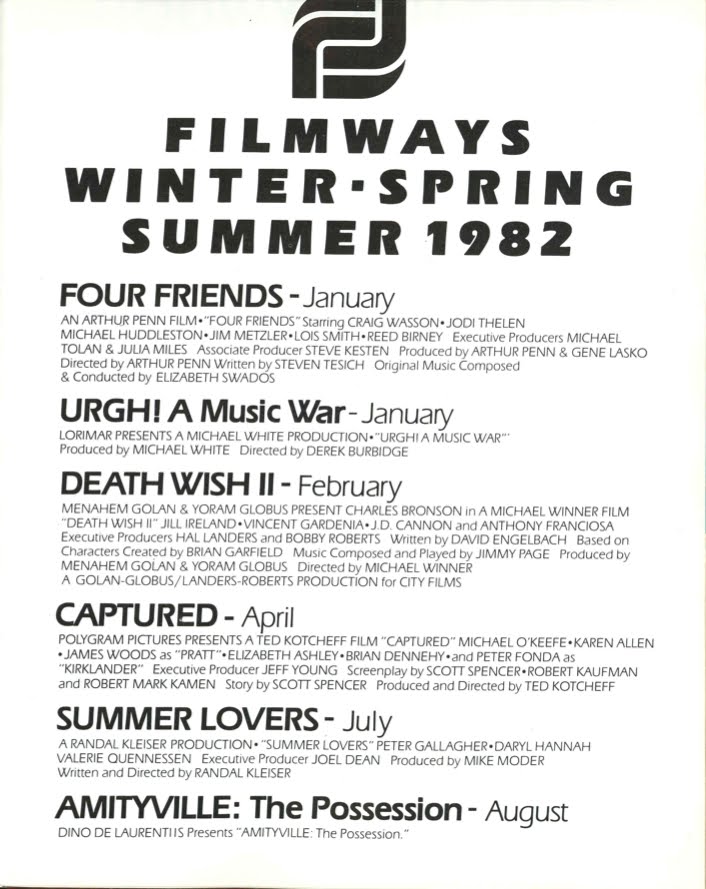
In an interesting 1982 interview with Stephen Brunt of Canada's Globe and Mail, Kleiser says that he was inspired by French comedies when conceiving the film. "I like the kind of romantic comedies that they make in France that are about relationships that change." To be fair to Kleiser regarding the underexplored elements of the relationships, he was hamstrung by studio restrictions. According to the same interview, Kleiser made the film at the smaller Filmways studio because the other studios were afraid of the racier elements of the story and Filmways was the only one willing to allow Kleiser to have all three principals living under the same roof. In the Los Angeles Times, Kleiser told Dale Pollock that he purposely did not go further with the portrayal of the women's relationship. "In order to get across this spirit of freedom, I had to be careful not to turn off a large segment of the audience that couldn't cope with that aspect."

Amazingly, Gallagher has mostly been derogatory towards this film over the years, although he has softened his stance more recently. Look at the promotional photos that adorn this article and watch the film and I think you will agree that Gallagher was smart to take on the role and equally wise to stop complaining about it. There was an amusing brief blurb in either Entertainment Weekly or Premiere about ten years ago that mentioned that Gallagher had visited Santorini for the first time since he shot Summer Lovers. He apparently was flanked by his wife and mother-in-law, leading locals to observe not only that he had returned to the isles, but that he once again had the companionship of two women. I wish I still had that clipping because I cannot recall the exact details.

One of several films to explore same-sex relationships in 1982--
Personal Best,
Making Love, and
Lianna were the others--
Summer Lovers is particularly perplexing in its hesitancy to take the next step if only because director Kleiser is the only openly gay director of the four films. I realize I am simplifying the issue quite a bit, but I find the irony interesting nonetheless. As much as I adore Quennessen, and her character, Lina, I still find myself puzzled by Michael's disinterest in Hannah's Cathy. Hannah has her share of detractors, but I think she is especially good at projecting a genuine sweetness and endearing naivete. Here, she is at her most charming and beautiful (Janet Maslin thought
"bland") and she adores Michael, yet he runs off at the first chance.

As for Quennessen, she probably comes off the best of the three in terms of performance, in large part, because her character is exotic and has the most mystery about her, but I think she is even more beguiling in the earlier
French Postcards. In her review of that film, Maslin calls Quennessen an "irresistible French gamine" and I agree with her.
Unfortunately, the young actress retired prematurely from the screen after Summer Lovers to concentrate on raising a family. She was rather revealing during a press junket in New York for the film, which was quoted in a Globe and Mail article at the time. "When they called for the movie, I had to stop all what I'm doing. These Americans, they expect you drop everything for a movie. In France, we never get involved in the actor myth. We try to get close to the actors we work with. You can't get this close to American actors. They get so wrapped up in what they do that they ask themselves afterwards, 'Who am I?'" Her life would end tragically in a car accident in 1989, making her few film performances even more poignant.
In a smaller role, is the fine Dutch actor Hans van Tongeren. He plays Jan, the only person who seriously vies for either Cathy or Lina. Lina stays with him for a time, but is eventually drawn back to Cathy and Michael. Apparently, van Tongeren was vacationing on Santorini at the time of filming and was spotted by Hannah. She recognized the young actor from his work in Paul Verhoeven's
Spetters, for which he had deservedly received much acclaim and persuaded him to join the production. I'm not sure if the character was written for him or if the part was ready and waiting to be filled. In any event, van Tongeren's appearance is bittersweet because the role is intriguing, but rather small, and because this would be one of his final roles. Sadly, van Tongeren committed suicide in August of 1982 just around the time that
Summer Lovers opened. He is not able to make so much of an impression here, but in
Spetters it is apparent that he was a major talent. Verhoeven who is clearly haunted by his death speaks very highly of van Tongeren in this
biography. According the
Dutch Wikipedia entry for van Tongeren, the Dutch media reported that he had spent time in psychiatric wards and was perhaps too close to some of his roles, something that is particularly resonant when one thinks of his character in
Spetters.

In filming on the islands of Santorini, Delos, Mykonos, and Crete without really acknowledging all the island hopping within the film's narrative, Kleiser creates something of a Greek mega-island. Visitors to the islands will find the ease with which Cathy and Michael see all the sites that they do, quite impossible to duplicate in reality. This does not deter, however, from the great compliment Kleiser and his crew pay to the islands by virtue of the film's sumptuous cinematography. This is one of the best cinematic advertisements for tourism that I have ever seen--I'm living proof as are many of the members of this
forum.
In making the film on the islands, Kleiser sought to portray the easygoing, open lifestyle he witnessed there, especially amongst the many young people who congregated there in the summer and camped out on the beaches. In a New York Times article that appeared as the film was opening he spoke of the magic of the islands, "a mecca for young people from all over the world. You see cultures exchanging information, love affairs happening. And the Greeks are so honest. Campers left their backpacks in the town square and went off to the beach for the day. When they came back at night, nothing had been stolen." In the film, one gets hints at the sense of possibility and discovery on the islands and the ephemeral nature of it all, but it's not fully explored. In the interview with the Globe and Mail, Kleiser mentions doing "research screenings" with many young people in the audience and determining "whether they were with it or not." By the end of these screenings, the film had been cut from 130 minutes to 99. I wonder if some of the lost material would have supplied the film with more grist or nuance with regards to the aforementioned special qualities of the islands.
At one point, Kleiser told Pollock the script was to include five separate plots to be joined in the manner that his good friend George Lucas had done in American Graffiti. Ultimately, however, Kleiser was "fascinated" by "the couple's sexual and emotional liberation" and shifted entirely to their story. Before writing the script, Kleiser screened "numerous French films to capture the elusive tone of subtle sexuality." The idea of a multi-narrative script is intriguing, but rather than adding more characters, I think the film would probably be best served if Kleiser had turned his focus entirely onto one young character--male or female--and followed him or her from the moment of arrival on the island to departure, showing us the relationships and discoveries as they happened.

While Kleiser does not adequately explore the potential lesbian romance, he does not skimp on the onscreen nudity by the principals or the countless extras seen on nude beaches. If this movie were made today, I think it would be more daring in its approach to the relationship of the women, however I have a hard time believing it would contain nearly the amount of nudity that the film does. This points to the odd "progression" that Hollywood films have made over the years. They have become overwhelmingly prudish with regards to sex and nudity, but upped the quotient on toilet humor and violence. By the same token, mainstream film and television have become much more tolerant of gay content and characters. Although,
Summer Lovers disappoints in this regard, it must be praised for its non-exploitative, rather European treatment of onscreen nudity--much of it is of the casual, everyday variety, which is very refreshing to see in light of the current dearth of such content in mainstream cinema.

I have briefly mentioned the music, which I must once again praise. The film was said to be highly marketed on the then nascent MTV and it must be said that this is appropriate as Kleiser's soundtrack is very adeptly compiled collection of then-current synth pop and dance tunes--unfortunately much of the music, including the majority of Poledouris' fine score, is underrepresented on the
official, now out-of-print Warner Bros. LP. For a time it was the only way to way to obtain Depeche Mode's "Just Can't Get Enough" on U.S. shores, an indication that the soundtrack was a bit more prescient and cutting edge than it appears now.

Poledouris' rather brief, hauntingly beautiful score, though, really raises the film to a higher level in several cases. I think, particularly of the moments when Michael first sees Lina at the beach at Matala and then when they later go swimming together to the cave. These scenes are without dialogue, containing only Poledouris' lovely "Sea Cave" cue, enchanting locales, and longing glances in close-up. The film may have its share of fluff and shallowness, but these brief moments, for me, are what I think French critics Jean Epstein and Louis Delluc meant by photogenie. I have no doubt this interpretation has something to do with my infatuation with Ms. Quennessen.
UPDATE:
Summer Lovers, Complete Songs and Score (Ripped from DVD).
Some alternate versions of songs appear at the end of the album. I've given names to the score tracks aside from the 2 that appeared on the original album ("Sea Cave," "Search for Lina"). Cobbled together from a variety of sources, the Basil Poledouris score and otherwise unavailable songs are ripped from DVD and have not been further manipulated (dialogue and sound f/x included). The quality is rough on a few of these tracks, but keep in mind that a few only appeared as B-sides and/or on the original soundtrack album. I did not do the original vinyl rips so thanks to those who did the legwork. I've upgraded most of the tracks that are available in other places: